

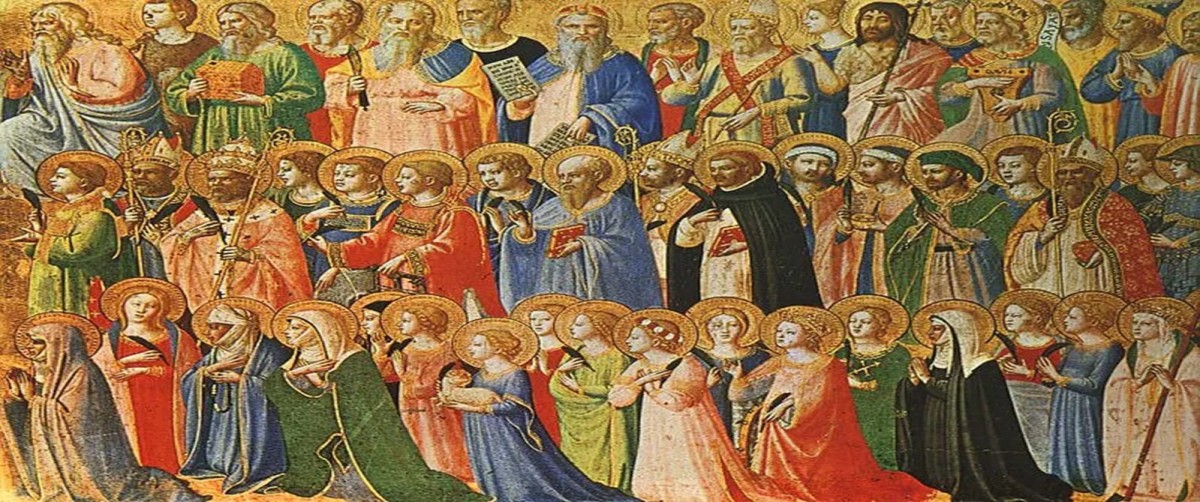
The Solemnity of All Saints honors all men and women who have entered Heaven, but we particularly focus on those who led extraordinarily holy lives and whom the Church has canonized as saints. They honored God in various ways: through deep prayer and mystical union, through martyrdom or persecution, or through service, such as caring for the needy. The saints include powerful preachers, miracle workers, and leaders, while others lived in obscurity or exile.
By honoring the saints, we honor and glorify God Who made them holy. Heaven will be the eternal glory of God through the lives of His saints. In Heaven, the saints’ virtues, sacrifices, prayers, and service will eternally manifest God’s mercy and goodness. Every saint in Heaven will join a continuous chorus of angelic praise and worship of God. With the Seraphim, Cherubim, and Thrones, the saints will cry “Holy, Holy, Holy…” With the Dominions, Virtues, and Powers, the saints will participate in God’s providential care of the New Heavens and Earth. With the Principalities, Archangels, and Guardian Angels, the saints will celebrate God’s protection and continuous communication with His sons and daughters. Heaven today, and the New Heavens and Earth at the end of time, will be a continuous solemn celebration of God in His essence and of all that He has done in the lives of those who responded to His grace.
Honoring the saints is an invitation to each of us to strive for the holiness the saints attained. The saints’ lives are a “how to” book in holiness. We study and ponder the lives of the “super saints”—such as the Blessed Virgin Mary and Saints Francis of Assisi, Catherine of Siena, Teresa of Ávila, Thérèse of Lisieux, Augustine of Hippo, and Thomas Aquinas—to learn from their examples. From Heaven, the saints are our powerful intercessors. God uses the saints and angels to mediate His grace. We rely upon their intercession as an act of faith by which we profess our belief in God.
Today’s solemnity has its roots in the earliest days of the Church. Even in New Testament times, the community of believers honored martyrs, beginning with the deacon Saint Stephen. More martyrs followed, as the Church suffered persecution under the Roman emperors from AD 64 through 311.
After Emperor Constantine I legalized Christianity in 313, public devotion to the martyrs flourished, their graves becoming churches and places of pilgrimage and prayer. On May 13, 609, Pope Boniface IV transformed the Roman Pantheon, a pagan temple, into a church dedicated to the Blessed Virgin and all martyrs. On November 1, 731, Pope Gregory III dedicated an oratory within Saint Peter’s Basilica to “all saints,” including the Apostles, martyrs, confessors, and all holy men and women, broadening commemoration of the saints to all who lived saintly lives. In 844, Pope Gregory IV extended the November 1 celebration to the entire Church. In 1484, Pope Sixtus IV made November 1 a holy day of obligation, adding a vigil day and octave to make the celebration nine days in all. The vigil for All Hallows’ Day was called All Hallows’ Eve, or Halloween, which has unfortunately lost its saintly focus and has become a secular, and even pagan, celebration.
All saints in Heaven, I thank you for the holy witness you each have given to the Church and rejoice in the blessings you now enjoy in Heaven. Please pray that all people will become holy, bearing witness to Christ with our lives, and will one day enter Heaven. May God pour forth an abundance of grace upon the world through the example you set and the prayers you now pray before His throne. All saints of God, pray for me. Jesus, I trust in You.
