

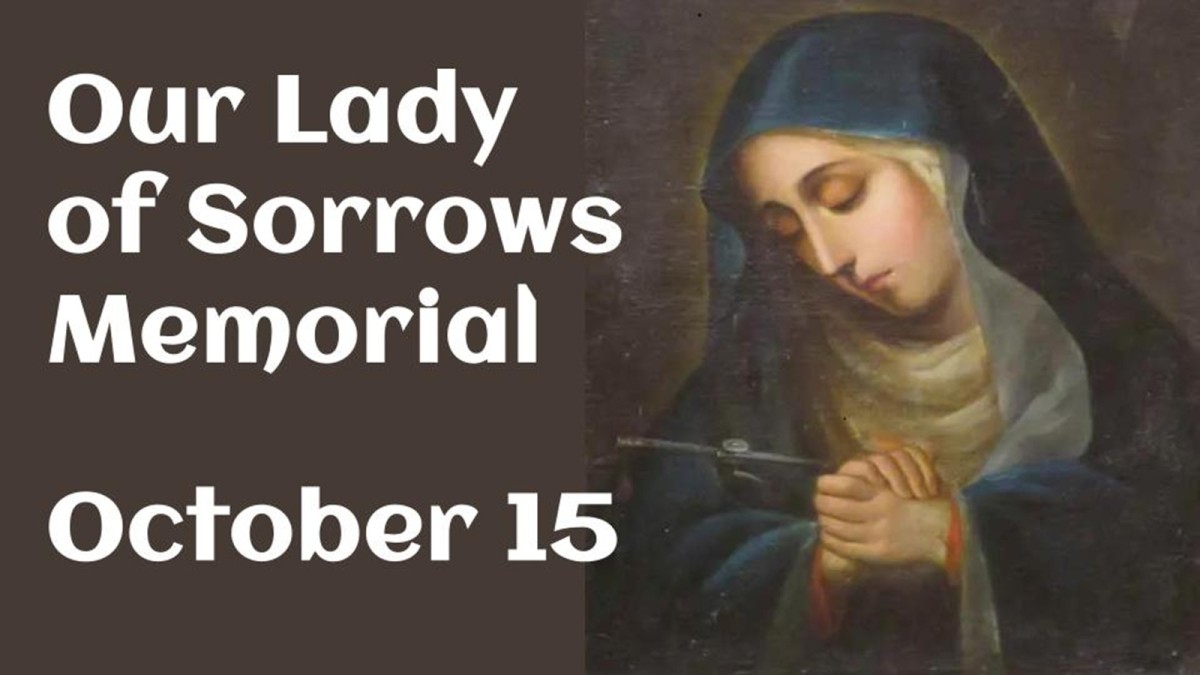
In 1233, seven devout men in Florence each had a vision from the Blessed Virgin Mary, inspiring them to form a religious community, later known as the Servites. Around 1240, these same men again had a vision of the Mother of God, accompanied by angels. She told them of their mission, provided them with their habits, presented their rule of life, and personally founded their order. In that apparition, Mary instructed them to spread devotion to her Seven Sorrows, which are rooted in the New Testament. Devotion to Our Lady of Sorrows had emerged during local celebrations around the Mediterranean in the eleventh century. Through the Servites’ efforts, the liturgical celebration honoring Our Lady of Sorrows gradually expanded.
In the late thirteenth century, the prayer, Stabat Mater (Standing Mother), was composed and quickly became well known. This prayer emphasizes the deep sorrow in Mary’s Heart as she stood before the Cross with tremendous strength and motherly compassion for her Son. The Servite Rosary with the Francicans.
In 1809, against the pope’s wishes, Napoleon annexed the Papal States to the French empire. After Pope Pius VII excommunicated Napoleon, the emperor arrested the pope and imprisoned him from 1809–1814. After Napoleon’s defeat in 1814, Pope Pius VII was released. In gratitude for the Blessed Mother’s protection of him and the entire Church, the pope extended the feast of Our Lady of Sorrows to the Latin Church.
Traditionally, the Memorial of Our Lady of Sorrows commemorates the seven sorrows in the Heart of Mary as recorded in Scripture:
- The prophecy of Simeon (Luke 2:33–35)
- The flight into Egypt (Matthew 2:13–15)
- Loss of the Child Jesus for three days (Luke 2:41–50)
- Mary meets Jesus on His way to Calvary (Luke 23:27–31; John 19:17)
- Crucifixion and Death of Jesus (John 19:25–30)
- The body of Jesus being taken from the Cross (Luke 23:50–54; John 19:31–37)
- The burial of Jesus (Isaiah 53:8–9; Luke 23:50–56; John 19:38–42; Mark 15:40–47)
The Blessed Virgin Mary learned about the sword that would pierce her heart while she and Saint Joseph presented the Child Jesus in the Temple on the eighth day for His naming and circumcision (Luke 2:34–35). Simeon’s prophecy is the first scriptural record of Mary knowing that her Son would suffer. The next six traditional sorrows paint the picture of the fulfillment of that prophecy.
A “sorrowful” heart differs from a “sad” heart. While sadness results from self-pity, or an unhealthy attachment to something that was lost, sorrow is the mourning mentioned in the Beatitudes (Matthew 5:4). In the Beatitudes, a heart that mourns is a heart that loves. Mourning, or holy sorrow, results from a heart that witnesses sin and grieves over it. The Blessed Mother witnessed her Son’s brutal treatment, rejection, suffering, and death. She did not despair, become angry, succumb to confusion and frustration, or withdraw into self-pity. Instead, she felt holy sorrow, grieving over the sins that inflicted her Son’s suffering and longing to see those sins redeemed.
Most Immaculate and Sorrowful Heart of Mary, thank you for your unending depth of compassion for those who sinned against your Son and for me. As you grieve with a holy sorrow over my own sins, please pray that I will more fully understand your compassion. As I do, I pray that I will more fully imitate and participate in that love, flowing from your pure and perfect Sorrowful Heart. Our Lady of Sorrows, pray for me. Jesus, I trust in You.