

First Century
Patron Saint of civil servants, accountants, bankers, bookkeepers, customs officers, financial officers, guards, moneychangers, money managers, stockbrokers, and tax collectors
Pre-Congregation canonization
Today’s saint emerged from the despised profession of tax collectors, seen as traitors to the Jews for collaborating with the Romans and often profiting by imposing extra taxes on their own people. Saint Matthew was most likely born as Levi, the son of Alphaeus. The name “Levi” implies that he was from the Tribe of Levi that was responsible for Jewish liturgical worship. It is almost universally accepted that the Levi in Mark 2:14 and Luke 5:27 is the same person called Matthew in Matthew 9:9. Possibly, Jesus gave Levi the name Matthew, meaning “Gift of Yahweh,” upon his conversion.
Levi’s call to follow Jesus changed his life in an instant. Likely working in Capernaum, where Jesus had been living in Peter’s home, Levi might have been corrupt, greedy, and ostracized by his Jewish community. His duties would have included collecting taxes on goods coming to Capernaum via the Sea of Galilee, as well as charging a toll to those who arrived there by boat. Matthew’s Gospel relates his conversion this way, “As Jesus passed on from there, he saw a man named Matthew sitting at the customs post. He said to him, ‘Follow me.’ And he got up and followed him” (Matthew 9:9).
Immediately after Matthew abandoned his occupation, he invited Jesus to dine at his house and Jesus accepted. Dining with them were other tax collectors and sinners. The Pharisees quickly condemned Jesus for associating with these men. Jesus rebukes them: “Those who are well do not need a physician, but the sick do. Go and learn the meaning of the words, ‘I desire mercy, not sacrifice.’ I did not come to call the righteous but sinners” (Matthew 9:12–13).
Throughout the rest of the Gospels, Matthew’s name is listed with the Twelve. He was present at the Ascension and at Pentecost. Early Church Fathers state that he remained for some time in Judea, preaching the Gospel and helping the newly formed Church. He might have penned his Gospel during this period. The Church Fathers commonly held that Matthew went to “Ethiopia,” but not in northeast Africa. Instead, he might have traveled to modern-day Iran or Armenia.
One legend holds that Matthew became a martyr while in ancient Ethiopia. In the story, Matthew thwarted King Hyracus’ desire to take Princess Ephigenia as his wife, telling Hyracus that she was a virgin consecrated to Christ. King Hyracus sent an assassin who fatally stabbed Matthew in the back while he stood at the altar, provoking such chaos and death that Hyracus’ brother became king, establishing Christianity as his kingdom’s official religion.
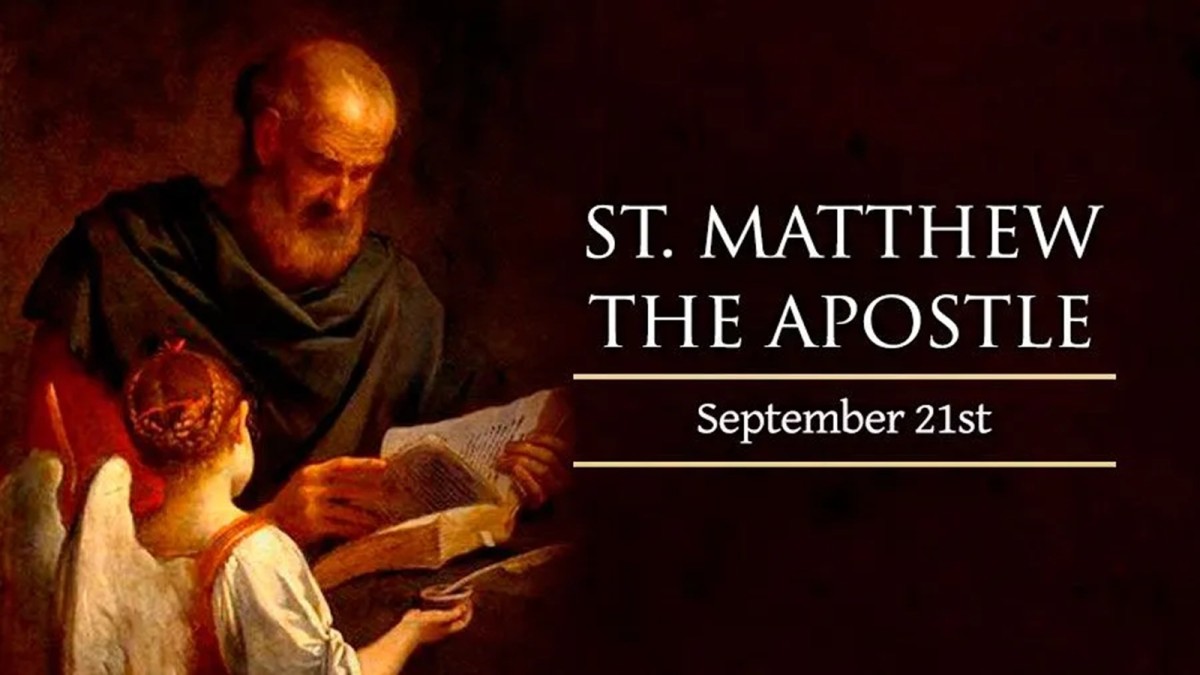
Saint Matthew’s most enduring gift is his Gospel, which early Church Fathers attribute to him unequivocally. Matthew’s Gospel was written by a Jew for his fellow Jews, likely written in Hebrew and Aramaic and later translated into Greek. His Gospel shows Jesus as the fulfillment of the Old Testament, the long-awaited Messiah. He begins with a lengthy genealogy tracing Jesus’ roots back to Abraham, the father of the Jewish nation. The Sermon on the Mount portrays Jesus as the new Moses, offering the New Law on the new mountain. Moses received the Law from God on Mount Sinai while the Son of God gives the New Law on the Mount of the Beatitudes.
Saint Matthew, the emptiness in your soul could not be filled with money, and you immediately left all behind to follow Christ. Please pray that I will never hesitate in saying “Yes” to God’s call in my life, so that God can transform my life and use me as He wills. Saint Matthew the Apostle and Evangelist, pray for me. Jesus, I trust in You.
