

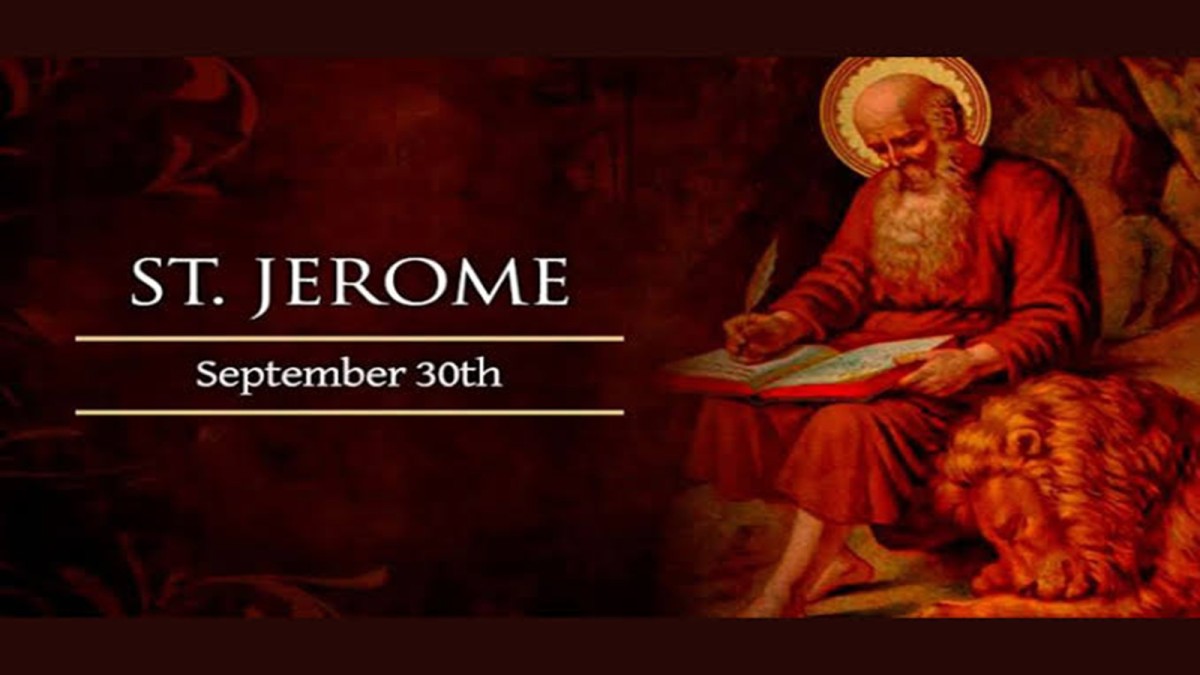
c. 340s–420
Patron Saint of archeologists, archivists, Bible scholars, librarians, libraries, schoolchildren, students, and translators
Pre-Congregation canonization
Declared a Doctor of the Church by Pope Benedict XIV in 1724
Eusebius Sophronius Hieronymus, later known as Jerome, was born in Stridon to Christian parents, somewhere in the Balkans. Thirty years after Emperor Constantine legalized the practice of Christianity in the Roman Empire, many still clung to Roman and Greek religions and philosophies.
Jerome’s parents sent the teenaged Jerome to Rome to study the classics. He learned Greek, in addition to the Latin he had known since childhood. Though a Christian, Jerome fell into sins of the flesh. Filled with guilt, he spent many Sundays visiting the catacombs to remind himself of death and the possibility of hell. Not baptized as a child, he chose to be baptized and began a conversion.
Around age thirty, Jerome traveled to historic Christian sites. In the Desert of Chalcis, he became a hermit for several years. He prayed, studied Greek, learned Hebrew, and translated various Christian books into Latin. During this time, a vision helped him realize that he was more attached to pagan literature than he was to Christ and His sacred Word. With that, he committed himself more fully to Christ and to a celibate life, vowing to devote himself to God’s Word and will, and to turn away from secular literature. Several years later, he returned to Antioch and was ordained a priest.
Around 382, Pope Damasus summoned Father Jerome to Rome to become his secretary and counselor. The Holy Father encouraged him to prepare an improved version of the Bible from the Greek and Hebrew translations. Father Jerome translated the Greek New Testament into Latin.
Father Jerome’s confrontation of corruption and calls for people to repent garnered criticism. Facing more hostility after Pope Damasus’ death, Jerome went to Antioch and then the Holy Land, accompanied by a group of holy women. He arrived in Bethlehem, where he would spend the rest of his life. He became a hermit in the caves near the Church of the Nativity and continued praying, studying and translating. He founded a monastery, and the holy women established a convent nearby.
In Bethlehem, Jerome spent about eight years translating the New Testament from the Greek and about fifteen years translating the Old Testament from the original Hebrew manuscripts. Western Church scholars accepted the work for its accuracy and clarity. His work was referred to as the “Vulgate,” the common translation, because it presented the Bible in a clear and easily understood way to the common people, in their own language. After the Protestant Reformation, in 1546, the Council of Trent declared Saint Jerome’s Vulgate to be Church’s official Latin translation. Father Jerome wrote commentaries on many Bible books, offering insights from his work of translation. He wrote on the saints, leaving some of the earliest historical documentation about their lives. He wrote extensively on Mary and the value of virginity, combated heresies, and wrote insightful letters.
Father Jerome died after thirty-eight years in Bethlehem and was recognized as a saint by popular consent. For his impact upon the Church, he was declared a Doctor of the Church in 1724.
Saint Jerome, God used you to provide the Church with a foundational understanding of the Scriptures. Your prayer, asceticism, and study show your love for God and His Church. Please pray that I will come to the same depth of love for the Scriptures so that I will come to the same love of God. Saint Jerome, pray for me. Jesus, I trust in You.
