

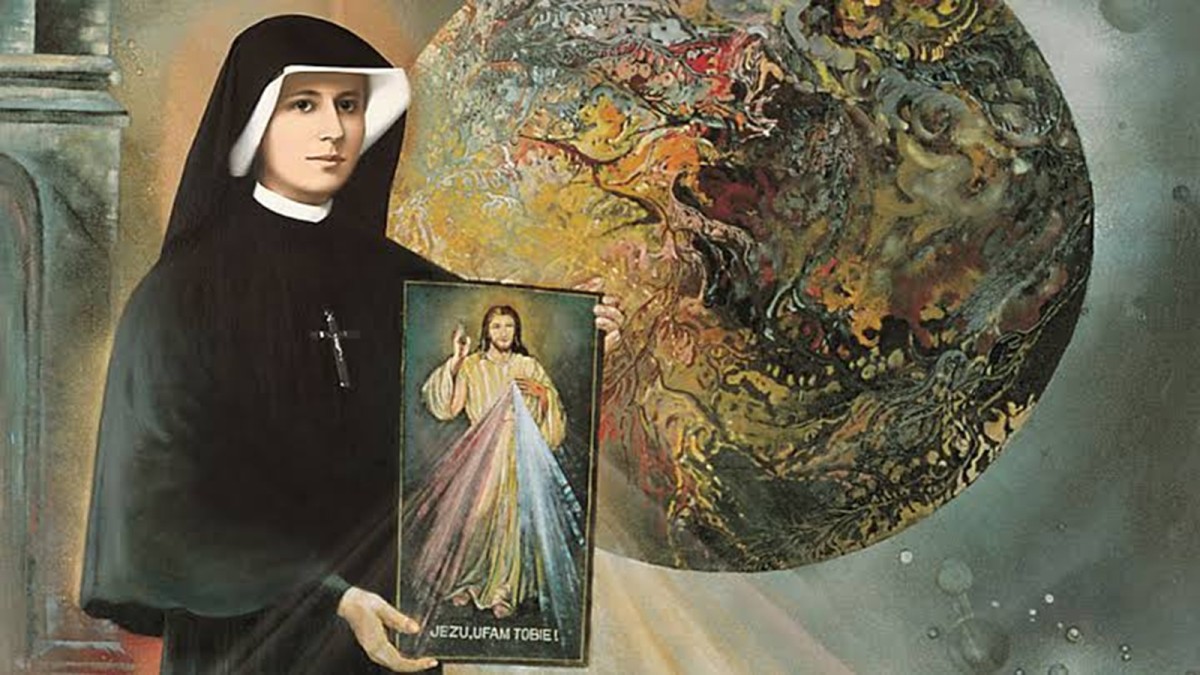
1905–1938
Patron Saint of The Divine Mercy devotion
Canonized by Pope John Paul II on April 30, 2000
Click here for Divine Mercy Chaplet
Helen Kowalska was the third of ten children born to a poor family in Glogowiec, Poland. With only three years of schooling, she loved to pray, obeyed her parents, and was sensitive to human suffering. From age seven, she sensed God calling her to the religious life. Her parents, though devout, refused their permission, and at eighteen, Helen turned herself “over to the vain things of life.”
One day, Helen experienced “deep torments while at a dance with her sisters.” Starting to dance, she had a vision of a bloodied and beaten Jesus at her side who asked how long she intended to put him off. Sneaking away to the Cathedral of Saint Stanislaus Kostka, she fell prostrate before the Blessed Sacrament and begged God for direction. As she prayed, she heard, “Go at once to Warsaw; you will enter a convent there.” With only the dress on her back, she left for Warsaw.
In Warsaw, Helen knocked on the doors of every convent but all turned her down. Finally, the mother superior at the Congregation of the Sisters of Our Lady of Mercy accepted her but noted in her diary that Helen “was no one special.” At age twenty, an “immensely happy” Helen was accepted into the Congregation. Soon frustrated with the convent’s busy schedule and her lack of prayer time, Helen decided to leave. Jesus appeared again to her, telling her that the convent was the place to which he had called her. Helen changed her mind, finished her novitiate, and on April 30, 1926, received the habit, and was given the name Sister Maria Faustina of the Blessed Sacrament.
Sister Faustina spent the next twelve years in the Sisters of Our Lady of Mercy’s convents in Poland and Lithuania. She died in Kraków on October 5, 1938, at age thirty-three. As a nun, Sister Faustina worked as a cook, gardener, and doorkeeper. Her ordinary duties were intertwined with incredible mystical experiences, in which Jesus delivered to her His message of The Divine Mercy. Obeying her superiors, beginning in 1934, she wrote down these visions and private revelations in six notebooks, now contained in The Diary of Saint Maria Faustina Kowalska: Divine Mercy in My Soul.
Faustina’s diary describes how Jesus wants devotion to His Mercy to spread. The first is by meditating upon the Divine Mercy image of Jesus with its blue (Baptism) and red (the Eucharist) rays shining from His Heart and the inscription, “Jesus, I Trust in You.” The second is by instituting the Solemnity of Divine Mercy on the eighth day of Easter. The third is by praying the Chaplet of Divine Mercy. The fourth is to honor the three o’clock hour, at which Jesus died, pouring forth His Mercy. Jesus also desired apostles of Mercy, who live mercifully and spread devotion to His Mercy.
Within two decades of Sister Faustina’s death, the Divine Mercy messages spread from Poland to other continents, but in 1959, the Vatican banned her diary and its devotions, for “serious theological reservations,” in particular for “excessive focus on Faustina herself.” In 1965, then-Cardinal Karol Wojtyła received Vatican permission to examine Faustina’s life and virtues, submitting his positive findings two years later. In 1978, when Cardinal Wojtyła was elected Pope John Paul II, the Vatican lifted its ban. Faustina was canonized on the eighth day of Easter, 2000, the first universal Church celebration of Divine Mercy Sunday.
Saint Maria Faustina Kowalska of the Blessed Sacrament, you listened and responded as God spoke to you. Through you, God revealed His invitation to live in His mercy. Please pray that the Ocean of Mercy pouring forth from Heaven will flood my soul and affect many others through me. Saint Faustina, pray for me. Jesus, I trust in You.
