

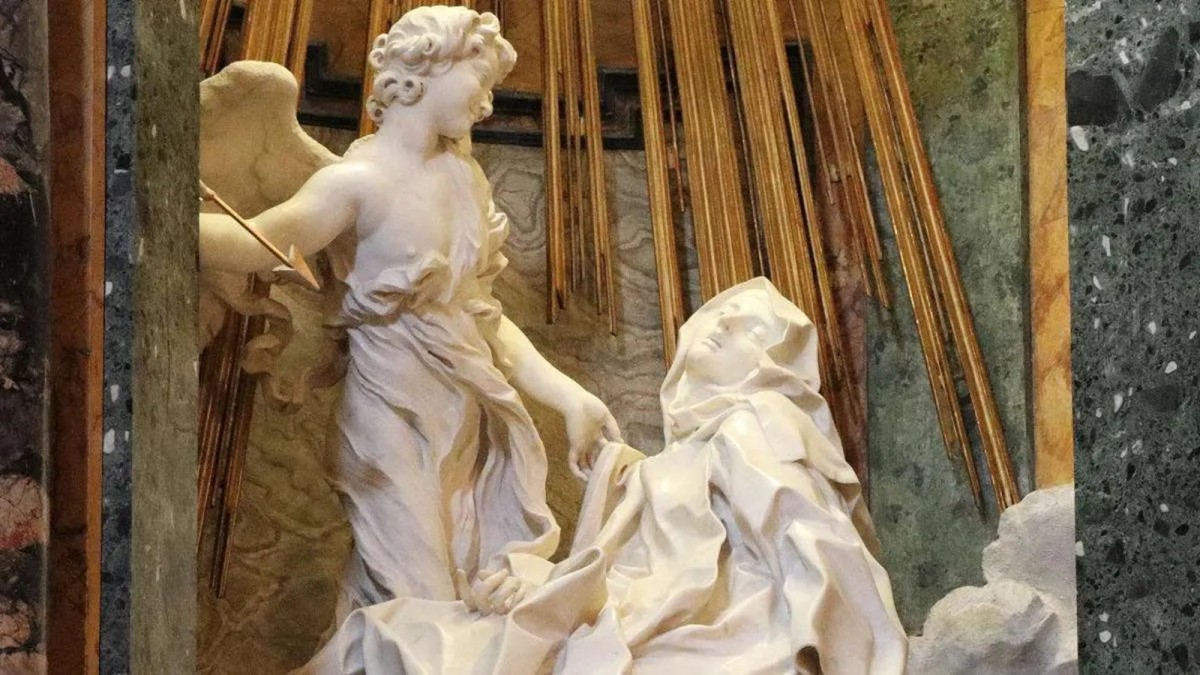
1515–1582
Patron Saint of Spain, lacemakers, and those in need of grace, in religious orders, and ridiculed for their piety
Invoked against bodily ills, headaches, and sickness
Canonized by Pope Gregory XV on March 12, 1622
Declared a Doctor of the Church on September 27, 1970
Saint Teresa of Ávila was born Teresa Sánchez de Cepeda y Ahumada in Ávila, Spain, one of nine children her father had and his second wife. By age seven, Teresa desired sainthood, even martyrdom. After her mother’s death when Teresa was twelve, she struggled with the lure of worldly attractions. Her father enrolled her in a nearby convent boarding school when she was sixteen. Peace entered her soul, but she developed a serious illness. Recovering at home, she debated becoming a nun. Once she decided to pursue her vocation, her father said “no.” When Teresa was twenty, she and her brother Rodrigo left their home secretly, both to enter religious life. Teresa entered the Carmelite Monastery of the Incarnation at Ávila on November 2, 1535.
After professing her first vows and taking the name Sister Teresa of Jesus, Teresa again fell ill and spent several years recovering in relatives’ homes. An uncle gave her a book on “the prayer of recollection” that became one of her treasures. Returning to the convent, she practiced the prayer of recollection, seeking God’s presence within her soul. She experienced the mystical “prayer of quiet” and “prayer of union.” Her continuous physical pain and the months of solitude and daily prayer bore great fruit. In 1542, she praised Saint Joseph for her miraculous recovery.
After ten years as a nun, Sister Teresa experienced a “second conversion” in her thirties. Passing by a statue of Christ crucified, she was overcome by grace and moved to the gift of tears. Reading Saint Augustine’s Confessions, she understood that she was avoiding the mystical journey to God. With deepened prayer, she experienced ecstasies and visions, even elevating in the chapel.
Many Spanish Carmelite convents had slipped into lukewarmness, worldliness, comfort, and a lack of prayer, including Sister Teresa’s own. She felt God calling her to reform the order. In 1562, she founded the convent of Saint Joseph in Ávila, becoming mother superior. Over the next five years, Mother Teresa wrote a new constitution for the reformed convent and The Way of Perfection, offering clear lessons for the sisters’ journey to holiness. The order resumed strict penances, prayer, solitude, and poverty. Going barefoot, they were called the “Discalced” Carmelites, meaning “without shoes.”
Mother Teresa traveled often, establishing seventeen convents in Spain. With her spiritual director, Saint John of the Cross, she founded two monasteries for men. The unreformed Carmelites opposed her, voting at a general chapter meeting in 1576 that Mother Teresa should stop all reforms and retreat into “retirement.” To solve the dispute, the pope decreed the two as separate provinces.
Mother Teresa’s four major books, several minor works, thirty-one poems, and 458 letters are among the most profound spiritual writings in Church history, earning her the title Doctor of the Church.
Saint Teresa of Ávila, God called you to religious life and then into a deeper, profound life of mystical union with Him. Please pray that I will come to know God with the same depth of knowledge, so that God can use me for the purpose to which He has called me. Saint Teresa of Ávila, pray for me. Jesus, I trust in You.
